
The book
Rummaging through the personal archive of a design master: Gastone Rinaldi’s story in his own words? Not exactly.
What emerges instead is the personality of a designer who was deeply human, generous and unpretentious. This is how it was told by everyone who knew him in the field: designers, architects and ex-collaborators. His personality was also considered harmonious and plain, like what radiates from his best designs, whether well-known or not.
If we venture into the pages of his archive with the intention of gleaning an idea about his personality, we begin by verifying two aspects: what is there? what isn’t there? So it is Gastone himself who talks to us through his choices about the company archive’s materials: letters, patents, dialogues about design perspectives with friends and already-prominent personalities who were admired as masters. We do not find a self-celebratory Gastone in this, either. We realize that it was not documents saved so that “posterity” could use to form ideas about how valuable his intuitions were. It was rather the accounts of personal relationships that made him, step by step, aware of the fact that he was part of the ideal community of Design.
Gastone Rinaldi designer alla Rima began from the interpretation about “what is present and what is missing” in the documents that he chose for himself, and the comparison, or almost validation, carried out through all the people who knew him and clearly remember him.
320 pages, 220 color photographs, size 21x24 cm, softcover. With the support of Letizia Carli Rinaldi who gave access to the archive Gastone Rinaldi.
Publisher
Capitolium Art
Publication Year
2015
Format
21x24 cm, softcover, paperback bound
Edition
320 pages, in color
Grafiche Antiga
Languages
Italian, with English translation
ISBN
978-88-941164-0-3

Contents
Opened by a foreword by Michele De Lucchi and an introduction by Marco Romanelli. With original documents from the Gastone Rinaldi Archive.
Divided in sections:

1 Rima: between chronicle and history
The first chapter examines the manufacturing context in which Gastone Rinaldi's contribution took place: Rima, an artisan company that experienced constant growth until it became a full-fledged industry.

2 Gastone Rinaldi's Design
Gastone Rinaldi's work as a designer is presented through patents, interviews, and testimonies from Rima workers. By observing some of Rima's products, we attempt to identify the fundamental characteristics of the designer's work.

3 Collaborations
Ponti, Zanuso, Rosselli, Campo and Graffi, Pozzi, Gerli, De Lucchi. These are just some of the external professionals who established relationships with Rima and collaborated with Gastone Rinaldi.

4 Architecture
In this chapter, Enrico Santangelo narrates Gastone Rinaldi's leap in scale from interior design to architecture, in creating a home tailored to measure for himself and his family.
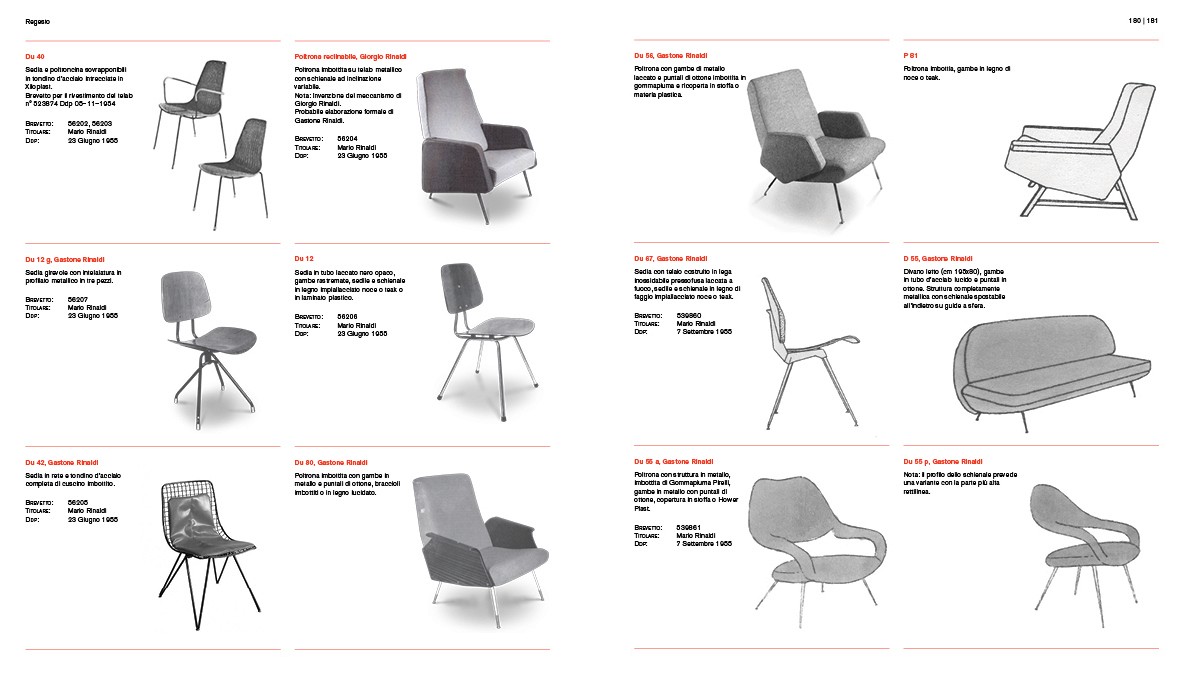
5 Register
54 pages presenting more than 300 models of chairs, cinema seating, furnishing accessories, tables, storage units, bookcases, beds, lighting, and school furniture produced between 1948 and 1974.

6 Documents
48 unpublished documents from the Gastone Rinaldi Archive: patents, sketches, and correspondence between Gastone and leading names in industrial design.

7 English Translation

The authors
Giuseppe Drago
Over the years, Giuseppe Drago has gathered a small collection of Rima products. After studying Humanities, he dedicated himself to antique restoration, making it his profession and specializing in twentieth-century furniture. In recent years, he has also been handcrafting products of his own design. He lives and works in Padua.
Jacopo Drago
Jacopo Drago studied design at the University of Bolzano, with periods also at Bilgi University in Istanbul and the University of Art and Design in Kyoto, graduating in 2014 in industrial design with a thesis on Rima. Since 2015, he has been active in the furniture and interior design sector in Japan.
Enrico Santangelo
Registered with the Chamber of Architects of Padua, he works as a freelancer focusing on residential and commercial architecture. In 2008, he contributed to the drafting of the design model manual "The typologies of sports facilities" in collaboration with the Veneto Region and CONI Veneto. In 2009, he curated the exhibition "Homage to Carlo Scarpa designer" in collaboration with the Province of Padua, the Municipality of Limena, and the Municipality of Altivole.